Schedule a Free Consultation for Door ReplacementSchedule a Free Consultation for Door Replacement
Designing and constructing outdoor living spaces on the 30th floor is an entirely different engineering challenge compared to a ground-level patio. When dealing with high-rise balconies, rooftop terraces, and elevated podiums, architects and contractors face a brutal combination of extreme weather, strict building codes, and significant structural demands.
While plastic (polypropylene) supports are fantastic for many ground-level commercial projects, high-altitude environments require a more robust solution. Here is an expert look at why stainless-steel pedestals are not just an upgrade, but an absolute necessity for high-rise balcony projects.
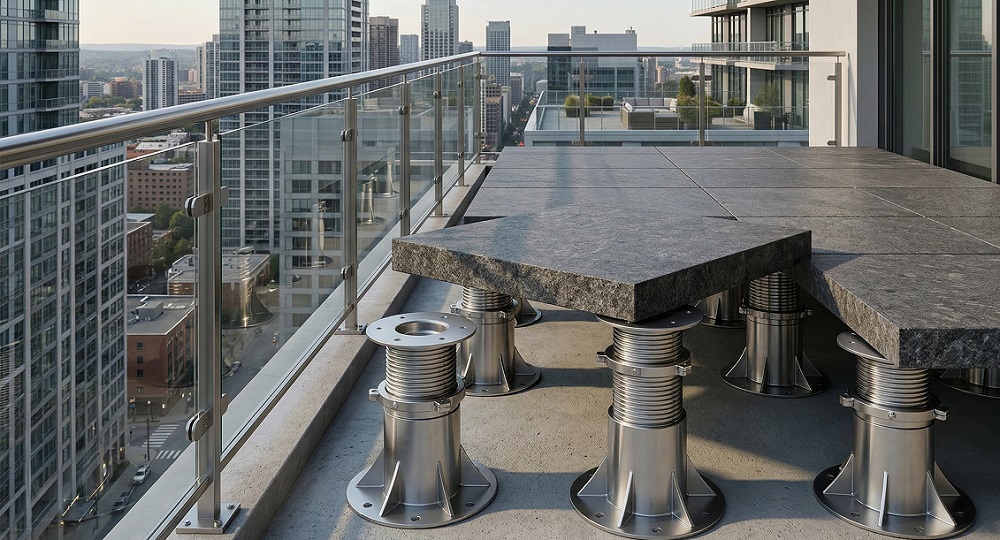
At high altitudes, building materials are subjected to continuous stress. The two most critical factors that architects must solve for are fire safety and wind dynamics. When a failure occurs on a high-rise balcony, it isn't just a maintenance issue; it is a severe safety hazard. This is where metal support systems prove their worth.
Following recent global shifts in building safety regulations (such as updates to the International Building Code and European fire safety standards), combustible materials are increasingly banned on the exteriors of high-rise buildings.
For elevated decks above a certain height, building inspectors now mandate the use of non-combustible decking support systems. Stainless steel provides an inherent Euroclass A1 fire rating. Unlike plastic, which can melt or contribute to fuel load in the event of a fire, Class A fire-rated paving pedestals made of stainless steel maintain their structural integrity, ensuring that emergency escape routes remain stable and compliant with the strictest municipal codes.
High-rise buildings act as sails, catching wind and creating massive updrafts along the facade. When this wind hits a balcony, it creates a vacuum effect that can lift pavers or decking tiles right off their supports.
Addressing wind uplift resistance in high-rise buildings is a primary concern for structural engineers. Stainless-steel pedestals offer a significant advantage here. Their substantial weight, combined with mechanical fixing options (such as locking heads and base plates that can be securely bolted to the substrate), creates a rigid, unified grid. This prevents the decking surface from shifting or lifting, even during severe storms or hurricane-force winds.
High-end commercial balconies often feature heavy surface materials, such as thick natural stone, large-format concrete pavers, or even outdoor structural glass.
Supporting these dense materials—along with the dynamic load of crowds, outdoor furniture, and planters—requires a foundation that will not warp or compress over time. Utilizing heavy-duty stainless-steel adjustable pedestals ensures a massive weight-bearing capacity (often exceeding 2,000 kg per pedestal). Metal threads do not strip under pressure, ensuring the finished floor level remains perfectly flat and stable for decades, without the risk of the "spongy" feeling that can sometimes occur with overloaded plastic supports.
Balconies are fully exposed to the elements. In a single year, a rooftop terrace might experience freezing snow, intense UV radiation, and baking summer heat. While high-quality plastic pedestals are UV-treated, metal is fundamentally immune to UV degradation. Furthermore, stainless steel (especially 304 or 316 marine-grade) expands and contracts minimally with temperature fluctuations, preventing the paving grid from shifting out of alignment during the freeze-thaw cycles of harsh winters.
Choose Adjustable Plastic Pedestals when: You are working on ground-level plazas, residential patios, indoor raised floors, or low-rise commercial decks where budget is a primary constraint and fire codes permit combustible supports.
Choose Stainless-Steel Pedestals when: You are building above 18 meters (or local high-rise code thresholds), require non-combustible A-class fire ratings, need to secure a deck against high wind uplift, or are supporting exceptionally heavy architectural pavers.
When specifying materials for high-rise balconies, the margin for error is zero. The support system is the hidden foundation of the entire outdoor space. By investing in stainless-steel pedestals, developers and contractors ensure regulatory compliance, protect against extreme weather, and deliver a safe, permanent solution that matches the lifespan of the building itself.


 IPv6 network supported
Our hours
8:00 AM – 6:00 PM, Mon-Fri.